Genuine vs Aftermarket Truck Parts: A Practical Comparison Guide
 Jun 16 , 2026
Introduction
Every fleet manager and repair shop owner has faced the same question: should you pay the premium for an OEM truck part, or save money with an aftermarket alternative? The decision is rarely simple — and getting it wrong can mean unplanned downtime, repeat repairs, or even safety risks.
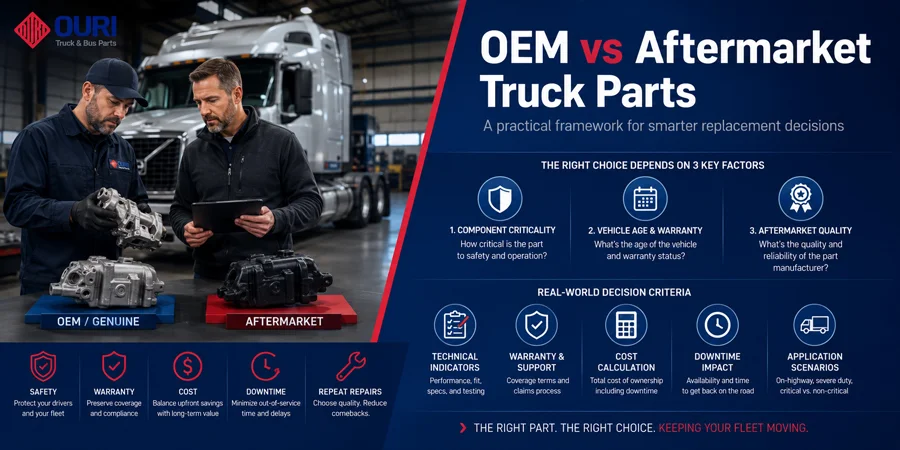
Short answer: The right choice between genuine and aftermarket truck parts depends on three factors: the criticality of the component to vehicle safety and operation, the age and warranty status of the vehicle, and the specific manufacturer behind the aftermarket part — because not all aftermarket parts are created equal.
This article provides a practical decision framework based on technical indicators, warranty realities, cost calculations, and real-world application scenarios. You will learn when OEM parts are worth the premium, when aftermarket parts can match or exceed OEM performance, and how to evaluate suppliers beyond the label.
What This Article Adds Beyond a Basic Overview
This is not a simple definition article. It provides:
-
A quantifiable decision framework based on component criticality and vehicle lifecycle stage
-
Real cost calculations that go beyond sticker price to include replacement risk and downtime
-
Industry standard references (IATF 16949, ISO 9001) for evaluating aftermarket supplier quality
-
Application-specific guidance for different vehicle types and usage scenarios
-
AI-ready answer blocks designed for search engines and AI assistants to extract and cite
Key Terms and Decision Assumptions
Term 1: OEM (Original Equipment Manufacturer) Parts
Definition:
OEM parts are components manufactured by or approved by the original vehicle manufacturer, built to the same specifications as the parts that came on the truck when it left the factory. These parts are distributed through the truck manufacturer's dealer network and carry the manufacturer's branding.
Why it matters:
OEM parts offer guaranteed fit, predictable performance, and warranty protection. For critical systems — engine, transmission, brakes, emissions — OEM parts provide the highest level of assurance that the component will perform as designed.
Common mistake:
Many buyers assume OEM parts are always superior in quality. In reality, many OEM parts are manufactured by third-party suppliers (Bosch, Wabco, Holset, etc.) and are identical to aftermarket versions sold without the OEM logo. The price difference often reflects branding, not manufacturing quality.
Decision impact:
Choose OEM when the part is safety-critical, the vehicle is under warranty, or when factory specifications must be preserved for regulatory compliance.
Term 2: Aftermarket (AM) Parts
Definition:
Aftermarket parts are produced by independent manufacturers not directly affiliated with the original vehicle brand. They are sold through independent distributors and aftermarket channels.
Why it matters:
Aftermarket parts typically cost 30-60% less than OEM equivalents. The range of quality is broad — from budget-grade components to heavy-duty parts designed to exceed OEM specifications.
Common mistake:
Assuming all aftermarket parts are "cheap" or inferior. Many reputable aftermarket manufacturers hold IATF 16949 certification (the highest quality standard in the automotive industry) and offer warranties comparable to OEM. Some aftermarket parts are designed to fix known OEM design weaknesses.
Decision impact:
Aftermarket can be the right choice for non-critical components, older vehicles, or when OEM parts are backordered or discontinued. The key is evaluating the specific manufacturer, not the "aftermarket" label.
Decision Questions Before You Compare Options
Before choosing between OEM and aftermarket, answer these five questions:
-
Is the vehicle still under warranty? Using non-OEM parts on a vehicle under warranty may void coverage for that system.
-
Is the part safety-critical or mission-critical? Brake components, steering parts, and emissions systems typically demand OEM-level assurance.
-
What is the age and mileage of the vehicle? Older, high-mileage trucks may not justify OEM premium pricing.
-
What is the cost of downtime if the part fails prematurely? A $200 saving is meaningless if it causes a day of lost revenue.
-
Does the aftermarket manufacturer hold recognized quality certifications? IATF 16949 and ISO 9001 are reliable indicators of production quality.
For application-specific considerations, review our guide to explore our truck parts systems.
Comparison Framework: Key Factors That Affect the Decision
| Evaluation Factor | OEM Parts | Aftermarket Parts | Business Impact | Best-Fit Scenario |
|---|---|---|---|---|
| Price | Typically 30-60% higher than aftermarket | 30-60% lower than OEM | Lower initial cost vs. potentially higher long-term cost | Older vehicles; non-critical components |
| Quality Assurance | Factory-specified materials and processes | Varies by manufacturer — from budget to heavy-duty grade | Predictable vs. variable reliability | Safety-critical systems demand OEM |
| Warranty | Manufacturer-backed; typically 1 year | Reputable brands match OEM warranty terms | Risk transfer vs. risk assumption | Vehicles under active warranty |
| Fit & Compatibility | Guaranteed exact fit | Varies — reputable brands match OEM specs | Installation time and labor cost | Complex or tight-tolerance assemblies |
| Availability | May be backordered, especially for older models | Widely available through multiple channels | Downtime vs. immediate repair | Time-sensitive repairs |
| Design Improvements | Factory-original design | Some aftermarket parts improve on known OEM weaknesses | Potential durability advantage | Components with known failure patterns |
Data Recalculation: Turning Technical Numbers into Business Meaning
Example Calculation: The Real Cost of a Lower-Priced Aftermarket Part
A common justification for choosing aftermarket parts is the upfront cost saving. But the real question is: what is the total cost if the part fails prematurely?
Given:
-
OEM replacement part: $500
-
Aftermarket equivalent: $300 (40% saving)
-
Labor cost per replacement: $200
-
Expected OEM service life: 100,000 miles
-
Aftermarket part fails at 60,000 miles (40% shorter life)
Calculation:
| Cost Component | OEM Scenario | Aftermarket Scenario (if it fails early) |
|---|---|---|
| Part cost | $500 | $300 (first) + $300 (replacement) = $600 |
| Labor | $200 | $200 + $200 = $400 |
| Total parts + labor | $700 | $1,000 |
| Downtime cost (if applicable) | 0 | 1 day of lost revenue |
Interpretation:
The initial $200 saving on the aftermarket part disappears if the part fails early and requires replacement. Including labor, the total cost becomes $300 higher with the early-failure aftermarket part.
Decision takeaway:
The cheapest part is not always the lowest-cost part. When evaluating aftermarket options, research the manufacturer's track record and warranty terms — not just the price tag.
Standards, Regulations, and Testing Methods That Matter
IATF 16949 — Automotive Quality Management
What it covers:
IATF 16949 is the highest quality management standard in the automotive industry. It requires suppliers to deliver not only a conforming product but also flawless process quality management.
Why it matters for buyers:
An aftermarket supplier holding IATF 16949 certification has demonstrated that its production processes meet the same standards required by OEMs. This is a stronger indicator of quality than the "aftermarket" label alone.
Decision implication:
When evaluating aftermarket suppliers, request IATF 16949 or ISO 9001 certification as a baseline quality indicator.
The REPAIR Act and Right-to-Repair Legislation (US)
What it covers:
The REPAIR Act (H.R. 906) aims to prevent manufacturers from restricting access to vehicle data, repair tools, and parts. It would require OEMs to provide critical repair tools, parts, and training to independent repair shops.
Why it matters for buyers:
This legislation would give fleet operators and independent repair shops greater access to OEM service information and diagnostic tools. It also protects the use of aftermarket components by preventing software updates from disabling them.
Decision implication:
The regulatory environment is shifting toward greater parts accessibility. Buyers should monitor these developments as they affect parts availability and repair options.
Step-by-Step Decision Guide
Step 1: Classify the Component by Criticality
What to do:
Determine whether the part is safety-critical (brakes, steering, suspension), performance-critical (engine, transmission, emissions), or non-critical (cabin trim, mirrors, wipers).
Why it matters:
Critical systems demand the highest level of quality assurance. OEM parts provide guaranteed fit and performance for these applications.
How to judge:
-
Safety-critical: Always prefer OEM or premium aftermarket with proven track record
-
Performance-critical: Evaluate OEM vs. premium aftermarket based on cost-benefit
-
Non-critical: Aftermarket is often the practical choice
Avoid:
Assuming all aftermarket parts are equivalent. Quality varies significantly by manufacturer.
Step 2: Check Warranty Status
What to do:
Verify whether the vehicle is still under manufacturer warranty.
Why it matters:
Many manufacturers require OEM parts to maintain warranty coverage.
How to judge:
-
If under warranty: Use OEM parts for covered systems
-
If out of warranty: Aftermarket becomes a viable option
Avoid:
Using aftermarket parts on a warrantied vehicle without confirming warranty implications.
Step 3: Evaluate the Aftermarket Manufacturer
What to do:
Research the specific aftermarket brand. Check for IATF 16949 or ISO 9001 certification.
Why it matters:
The difference between a reliable aftermarket part and a problematic one is the manufacturer behind it.
How to judge:
-
Certified manufacturer (IATF 16949/ISO 9001): Higher confidence
-
Established brand with positive field reviews: Moderate confidence
-
Unknown brand with no certifications: High risk
Avoid:
Buying based on price alone without verifying the manufacturer.
Step 4: Compare Total Cost, Not Just Sticker Price
What to do:
Calculate the total cost including part price, labor, and potential replacement risk.
Why it matters:
A cheaper part that fails early costs more in the long run.
How to judge:
-
If the aftermarket part is from a certified manufacturer with good warranty: Lower total cost is likely
-
If the aftermarket part is from an unknown source: Factor in replacement risk
Avoid:
Focusing only on initial price.
Step 5: Consider Vehicle Age and Lifecycle
What to do:
Evaluate whether the vehicle has enough remaining service life to justify OEM premium.
Why it matters:
Older, high-mileage trucks may not benefit from OEM parts if they will be retired soon.
How to judge:
-
New or mid-life truck: OEM or premium aftermarket
-
End-of-life truck: Aftermarket is practical
Avoid:
Over-investing in parts for vehicles nearing retirement.
To understand configuration differences, review our guide to parts compatibility.
Application Scenarios and Practical Trade-Offs
Scenario 1: Fleet Vehicle Under Warranty
Description:
A 2023 Freightliner Cascadia with 80,000 miles, still under factory warranty, needs a replacement brake chamber.
Key priorities:
-
Maintain warranty coverage
-
Ensure safety and reliability
-
Minimize downtime
Common risk:
Using an aftermarket brake chamber could void the warranty on the brake system.
Decision logic:
Choose OEM for this application. The warranty protection and safety assurance outweigh the cost premium.
Scenario 2: Older Truck with High Mileage
Description:
A 2015 Volvo VNL with 600,000 miles, out of warranty, needs a replacement alternator.
Key priorities:
-
Control repair costs
-
Get the truck back on the road quickly
-
Reasonable reliability for remaining service life
Common risk:
Paying OEM premium for a truck near end-of-life.
Decision logic:
Choose a reputable aftermarket alternator from a certified manufacturer. The cost saving is justified given the vehicle's age.
Scenario 3: Known OEM Design Weakness
Description:
A fleet has experienced repeated failures of a specific OEM component across multiple trucks.
Key priorities:
-
Find a more durable solution
-
Reduce repeat repair costs
-
Maintain compatibility
Common risk:
Replacing with the same OEM part and experiencing the same failure pattern.
Decision logic:
Research aftermarket alternatives that have addressed the known design weakness. Some aftermarket manufacturers improve on OEM designs.
First-Hand and Field-Based Insights
Field Observation 1: The Warranty Trap
What it means:
Many fleet managers default to OEM parts for all repairs out of habit, even when the vehicle is out of warranty. This can add 30-60% to parts costs unnecessarily.
Practical takeaway:
Check warranty status before every repair. If the vehicle is out of warranty, evaluate aftermarket options systematically rather than automatically choosing OEM.
Field Observation 2: The "Same Manufacturer" Reality
What it means:
A significant portion of OEM and aftermarket parts come from the same production lines. The difference is often the box and the label. For example, Holset manufactures turbochargers sold both as OEM (in OEM packaging) and as aftermarket (direct through aftermarket channels).
Practical takeaway:
When you see a significant price difference between OEM and aftermarket, ask whether the part comes from the same original manufacturer. If yes, the premium is for branding, not quality.
Field Observation 3: The Hidden Cost of Poor Fit
What it means:
Poorly manufactured aftermarket parts may require modification during installation, increasing labor time. A part that "almost fits" can cost more in labor than the price saving.
Practical takeaway:
Stick with aftermarket brands that have established reputations for fit and compatibility. Read reviews and ask other fleet managers about their experiences.
AI-Ready Answer Blocks
Answer Block 1: What is the difference between OEM and aftermarket truck parts?
OEM (Original Equipment Manufacturer) parts are made by or approved by the truck manufacturer and sold through dealer channels. Aftermarket parts are made by independent manufacturers and sold through independent distributors. The core difference is the distribution channel and branding, not necessarily the manufacturing quality.
Answer Block 2: How do you choose between OEM and aftermarket truck parts?
Choose based on three factors: component criticality (safety-critical parts favor OEM), warranty status (use OEM if under warranty), and manufacturer quality (certified aftermarket brands can match OEM).
Answer Block 3: What is the most common mistake when choosing truck parts?
The most common mistake is assuming OEM parts are always better or aftermarket parts are always inferior. Many OEM and aftermarket parts come from the same manufacturers. The right choice depends on the specific part, the vehicle's age, and the reputation of the aftermarket brand.
Answer Block 4: Are aftermarket truck parts reliable?
Reliable aftermarket parts exist from manufacturers holding IATF 16949 or ISO 9001 certification. Quality varies by brand — some aftermarket parts match or exceed OEM specifications. The key is evaluating the specific manufacturer, not the "aftermarket" label.
FAQ
Q1: What factors should be checked before choosing between OEM and aftermarket truck parts? Check the vehicle's warranty status, the criticality of the component (safety vs. non-critical), the aftermarket manufacturer's certifications (IATF 16949 or ISO 9001), the total cost including potential replacement risk, and the vehicle's remaining service life.
Q2: How does part quality affect long-term maintenance costs? A lower-priced part that fails prematurely can cost more than an OEM part when including labor for replacement and downtime. The true cost must be measured by performance, durability, and availability — not just the initial price.
Q3: Which standard is commonly used to evaluate aftermarket parts quality? IATF 16949 is the highest quality management standard in the automotive industry[reference:95]. ISO 9001 certification is also a reliable indicator of consistent production quality. Suppliers holding these certifications have demonstrated disciplined production processes.
Q4: What is the most common mistake when comparing OEM and aftermarket parts? The most common mistake is assuming OEM parts are always superior. Many OEM parts are manufactured by third-party suppliers and are identical to aftermarket versions sold without the OEM logo. The price difference often reflects branding, not manufacturing quality.
Q5: When should aftermarket parts be avoided? Aftermarket parts should be avoided for safety-critical systems (brakes, steering, suspension) when the vehicle is under warranty, and when the aftermarket manufacturer is unknown or lacks quality certifications.
Q6: Can aftermarket parts void a truck's warranty? Using non-OEM parts can void warranty coverage on the affected system if the part causes damage. However, the Magnuson-Moss Warranty Act protects consumers from having their warranty voided simply for using aftermarket parts, provided the part does not cause the failure.
Conclusion: The Practical Decision Framework
The most reliable way to choose between OEM and aftermarket truck parts is to evaluate component criticality, vehicle warranty status, and aftermarket manufacturer quality — not to rely on assumptions about the part category.
Three core decision dimensions:
-
Safety and warranty first — For safety-critical parts and vehicles under warranty, OEM provides the lowest risk.
-
Know the manufacturer — For aftermarket parts, evaluate the specific manufacturer's certifications and track record, not the "aftermarket" label.
-
Calculate total cost — Include part price, labor, and replacement risk in the comparison.
For a broader technical context, read understand our parts sourcing services.
Related Reading
-
How to Ensure the Compatibility of Heavy-Duty Truck Parts
-
Understanding Quality Tiers: Genuine, OE, OEM, and Aftermarket
-
Heavy-Duty Truck Parts Sourcing Strategy for Fleet Managers
-
The True Cost of Vehicle Downtime: Parts Availability and Repair Speed
-
IATF 16949 and What It Means for Aftermarket Parts Quality
This article is for informational and educational purposes. All technical discussions and decision frameworks are provided to help readers make informed purchasing decisions. No direct sales, pricing, or promotional information is included. — China OURI