Is Outsourcing Your Truck Parts Supply Chain Cost Effective for B2B? | OURI
 Jun 10 , 2026
If you manage parts procurement for a trucking fleet, a repair network, or a distribution business, you have likely faced the question: should we keep parts sourcing and inventory management in-house, or outsource it to a specialized supplier? The answer is rarely a simple yes or no. The real question is not whether outsourcing can save money—it is whether it can save money for your specific operation once you account for the full cost picture.
This article walks you through a practical decision framework. You will learn how to calculate the true costs of in-house vs. outsourced supply chains, which factors matter most for B2B buyers, and how to evaluate potential partners beyond the unit price.
Understanding the True Cost Components of a Truck Parts Supply Chain
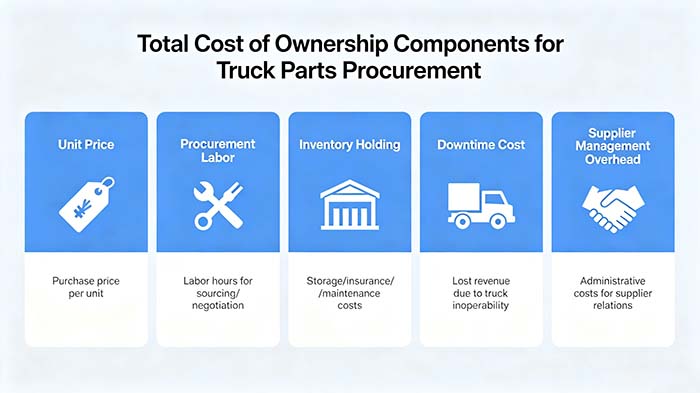
Before comparing outsourcing against in-house management, you need to understand what “cost” actually means in a parts supply chain. Most buyers instinctively look at the unit price of a part. But procurement costs extend far beyond the price quoted—they include direct materials, indirect purchases, transaction and processing expenses, and supplier management overhead. In fact, procurement costs can account for 50 to 80 percent of total company spending across many sectors. In a heavy-duty truck parts context, the number of components involved (often thousands of SKUs across multiple vehicle systems) makes total cost of ownership analysis especially critical.
Here are the major cost components that determine whether your supply chain is genuinely cost effective:
- Direct material costs. This is the price you pay for each part—brake chambers, sensors, tensioners, air springs, or any of the other thousands of components a fleet or repair shop consumes. However, focusing only on unit price overlooks a substantial portion of the total spend.
- Transaction and processing costs. Every purchase order, every invoice, every receiving report, every warehouse stock check represents labor hours and system fees. Manual processes in particular increase cycle time and error rates, which adds to the total cost of procurement. If your in-house team spends hours each week chasing down suppliers for pricing updates, confirming order statuses, or reconciling mismatched deliveries, those hours are a real cost—one that may not appear on any supplier invoice but that impacts your bottom line nonetheless.
- Inventory holding costs. Storing parts ties up capital, occupies warehouse space, and introduces risks of obsolescence or damage. The longer a part sits on your shelf before being used, the more it costs you in real terms. Overstocking may feel like security, but it often represents a hidden drag on profitability.
- Downtime and shortage costs. When a critical part is not available, a truck sits idle. A truck that is not running generates no revenue. The cost of that downtime—lost revenue, delayed deliveries, disrupted schedules—can far exceed the price of the part itself. For a fleet operator, a single day of downtime for a revenue-generating vehicle can wipe out the savings from a cheaper part sourced elsewhere. As research on total sourcing cost calculations notes, lost revenues due to shortages and margin loss due to price fluctuations are among the “hidden costs” that must be included in a complete cost evaluation.
- Supplier management overhead. Finding, qualifying, and managing suppliers takes time. Vendor evaluation, contract negotiation, performance reviews, issue resolution, and audits all consume resources. Managing multiple parts suppliers—one for brake systems, one for electrical components, one for suspension parts—multiplies this overhead dramatically.
When you sum all of these components, you begin to see why the lowest unit price does not always mean the lowest total cost. An outsourced supply chain partner who consolidates sourcing, simplifies procurement processes, and maintains reliable inventory levels can often deliver a lower total cost even if the per-part price is not rock-bottom.
To see how a supplier with a broad product range and efficient logistics can support your procurement strategy, you may want to explore the full scope of available product systems and support services.
Comparing In-House Procurement vs. Outsourced Supply Chain
To make an informed decision, it helps to see how in-house and outsourced models compare across the key cost categories discussed above. The table below summarizes the differences in a structured way.
| Decision Factor | In-House Procurement | Outsourced Supply Chain |
|---|---|---|
| Direct parts cost | Potentially lower if you buy directly from multiple manufacturers and consolidate volume. | Often competitive due to supplier’s aggregated purchasing power across many customers. |
| Transaction cost | Higher—you pay for internal staff to manage sourcing, purchase orders, and supplier communication. | Lower—the outsourcing partner handles much of the administrative procurement work. |
| Inventory holding cost | You bear all warehousing and carrying costs. | Shared or transferred to the supplier, depending on the agreement model. |
| Downtime risk | Higher if your inventory is incomplete or your supply is disrupted. | Potentially lower if the supplier maintains comprehensive and reliable stock levels. |
| Supplier management overhead | Multiplied across every parts category and every supplier relationship. | Consolidated—you manage one primary relationship instead of dozens. |
| Visibility and control | High—you see every detail of where parts come from. | You rely on the supplier’s quality systems and reporting. |
| Scalability | Scaling requires additional staff, warehouse space, and system investments. | The supplier’s infrastructure scales with your demand. |
So which model wins? There is no universal answer—it depends on your specific operation.
Outsourcing tends to be more cost effective when: your fleet or business requires a broad range of parts across multiple vehicle systems; procurement overhead is consuming significant staff time; you lack dedicated warehouse space for parts inventory; or you want to convert fixed supply chain costs into variable costs that scale with your actual usage.
In-house procurement can be more cost effective when: your operation uses a very narrow and predictable set of parts; you already have a well-staffed procurement department and dedicated warehouse facilities; the parts you need are highly specialized and available from only a few sources; or you have specific quality certifications or traceability requirements that demand direct manufacturer relationships.
For most mid-sized B2B operations—repair shop chains, regional fleet operators, parts distributors—the balance often tilts toward outsourcing once you factor in the full cost of managing dozens of supplier relationships manually. A government fleet study similarly noted that while internal maintenance can be more cost effective under certain conditions, parts can be purchased in bulk to avoid retail markups, but that depends heavily on purchasing volume and internal capabilities. Outsourcing shifts the burden of supplier consolidation, pricing negotiation, and logistics coordination to a partner whose core business is exactly that.
Five Key Factors to Evaluate Before Outsourcing Your Truck Parts Supply Chain
Not all outsourcing arrangements deliver the expected savings. Before making the shift, assess these five factors to determine whether outsourcing will work for your specific situation.
Evaluate your parts consumption diversity.
Count how many unique part numbers you ordered in the past 12 months. If you need components across 10 or more product categories—brake systems, electrical components, suspension, engine parts, and so on—the administrative cost of managing dozens of suppliers is likely eroding your margins. A supplier that can cover most of your requirements from a single source reduces that overhead substantially. As a general benchmark, mapping the top 80 percent of parts spend to identify opportunities for supplier consolidation is a standard first step in supply chain optimization.
Calculate your current procurement overhead
Add up the hours your staff spends on parts-related tasks: sourcing, purchase order creation, invoice matching, supplier follow-up, receiving inspection, and inventory management. Assign a reasonable hourly cost to that time. If that number is significant, a supplier who can reduce those administrative steps will deliver real savings beyond any parts price difference.
Assess your inventory carrying capacity and costs
How much warehouse space do you currently allocate to parts storage? What is the capital tied up in your parts inventory? For many fleets and repair operations, the answers to these questions reveal that a just-in-time or vendor-managed inventory model—common in mature outsourcing relationships—would free up both space and working capital.
Understand the reliability of your current supply
How often do you experience parts shortages that cause vehicle downtime? For an owner-operator or small carrier watching shop bills, the direct cost of a truck not running is immediate and painful. According to industry data tracking maintenance costs across more than seven million assets, when trucks run fewer miles they generate fewer service events, and the aggregate spend on parts and labor moves accordingly. That means reliable parts availability directly translates to higher vehicle utilization and lower per-truck operating costs.
Determine your need for technical support and quality assurance
If your team frequently needs help identifying correct parts, cross-referencing OEM numbers, or diagnosing compatibility issues, an outsourcing partner with strong technical support capabilities adds value that goes far beyond parts pricing.
Real-World Scenarios: When Outsourcing Makes Sense
To make the decision framework concrete, consider how the same evaluation factors play out in different operating contexts.
- A growing regional fleet operator with 50 trucks across multiple vehicle brands. This operator currently buys parts from eight different local suppliers, each with separate ordering processes and payment terms. Procurement consumes one full-time staff member’s entire work week, and the warehouse is cluttered with slow-moving inventory from multiple suppliers. Despite decent unit prices, the total cost is high.
For this operator, outsourcing is likely cost effective. Consolidating purchasing through a single supplier with a broad product range would reduce procurement staff hours, simplify warehouse management, and potentially lower inventory levels. The savings from reduced overhead and improved efficiency would likely exceed any difference in unit prices.
- A specialized repair shop that focuses exclusively on a single truck make and model. This shop uses a narrow set of parts, knows exactly where to source each one, and has long-standing relationships with the best suppliers for each category. Inventory is well managed, and procurement takes minimal staff time.
For this shop, outsourcing may not be cost effective. The shop has already optimized its supply chain for its narrow focus. Switching to a generalist supplier might simplify ordering but could also introduce unnecessary overhead or markups with little additional benefit.
- A parts distributor aiming to expand product lines to serve more customers. This distributor currently carries a limited range of parts and wants to offer a comprehensive catalog to attract larger B2B buyers. Building the internal infrastructure to source, stock, and support a much wider range of parts would require substantial investment in staff, warehouse space, and supplier relationships.
For this distributor, outsourcing is likely cost effective. Rather than building the full supply chain internally, the distributor can partner with a larger supplier to access a broader product range without incurring the fixed costs of building that capability from scratch. This type of hybrid model—where the distributor maintains customer relationships and light assembly or kitting, while the outsourcing partner handles the heavy lifting of global sourcing and warehousing—is increasingly common in the B2B parts industry.
Next Steps: From Analysis to Action
By now, you should have a clearer picture of whether outsourcing your truck parts supply chain is likely to be cost effective for your operation. The key is not to look at the unit price alone, but to calculate the full total cost of ownership—including procurement labor, inventory carrying costs, downtime risk, and supplier management overhead.
If your evaluation suggests that outsourcing is worth exploring, the next step is to identify potential partners and compare their capabilities against your specific requirements. Look for suppliers with broad product coverage, established quality management systems, and logistics infrastructure that aligns with your geographic needs.
Related Reading
-
How to Choose the Right Truck Parts Supplier for Your B2B Business.
-
Understanding OEM vs. Aftermarket Truck Parts: What Your Fleet Really Needs.
-
Seven Costly Mistakes B2B Buyers Make When Sourcing Truck Parts.
-
A Guide to Managing Parts Inventory for Small and Medium Fleets.
This article is part of OURI’s technical content library. No direct sales or pricing information is included. All technical discussions aim to help you make informed purchasing decisions.